All writing
Content Strategy20 min read
How to Write Content That Ranks Without Keyword Stuffing
How to Write Content That Ranks Without Keyword Stuffing — a practical guide for Hong Kong businesses.

The Google BERT update in 2019 was the beginning of the end for string-based matching, yet I still see founders in Hong Kong hiring agencies that charge by the 'keyword' and measure success by 'keyword density.' They are basically buying a map of a city that hasn't existed for a decade. Imagine walking into a high-stakes board meeting at the Landmark in Central, trying to pitch a new fintech platform, and your entire communication strategy is based on repeating the phrase 'financial technology' every three sentences. It would be insulting to the audience, and it's equally insulting to the sophisticated algorithms that now crawl your website.
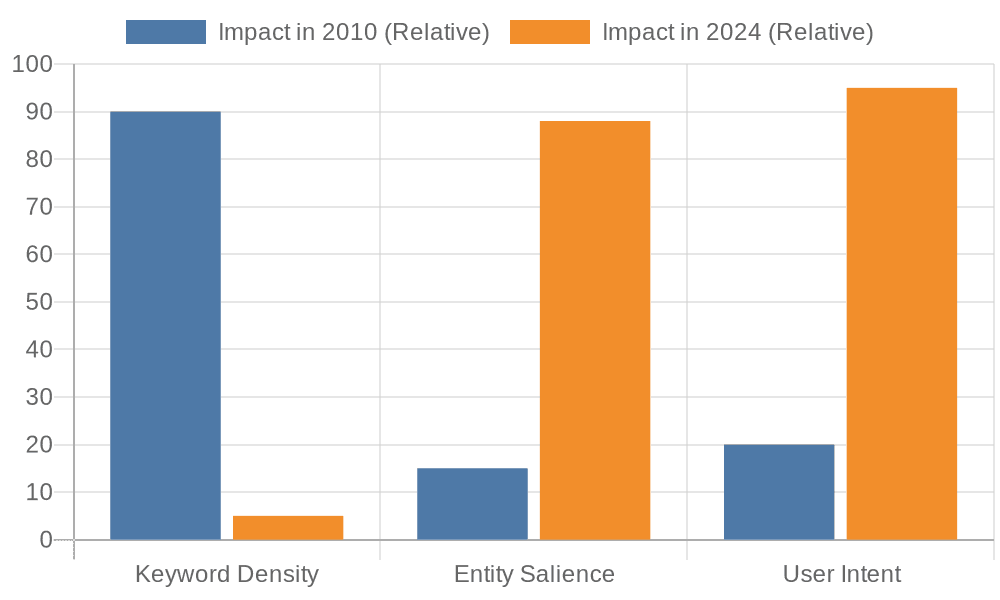
If you are still counting how many times a phrase appears on your page, you are playing a game that Google stopped playing five years ago. Today's search environment is governed by Entity Salience, BERT (Bidirectional Encoder Representations from Transformers), and the Helpful Content System. These algorithms don't count strings; they map relationships between concepts. They are looking for depth, not repetition. They are looking for the 'why' behind the words, the authority of the author, and the actual utility of the information provided. In this guide, I’m going to break down exactly how I write content that dominates the SERPs without ever worrying about a keyword density percentage.
02The Death of the Keyword Density Myth
Back in 2010, SEO was simple: if you wanted to rank for 'blue shoes,' you wrote 'blue shoes' fifty times, hid some in the footer using white text on a white background, and maybe bolded a few instances for good measure. It was a time of 'gaming the system.' In 2024, that behavior is a fast track to a 'Helpful Content' penalty. Google’s transition from 'Strings' to 'Things' means the algorithm now understands that 'Barack Obama' is a person, '44th President' is a title, and 'Michelle Obama' is a spouse. It doesn't need to see '44th President' repeated to know what the article is about.
This shift was driven by the need to understand consumer behavior and the nuances of human language. Google realized that people don't search in rigid keywords; they search in questions, phrases, and intent. The old way of stuffing keywords was essentially trying to speak 'search engine,' but search engines have now learned to speak 'human.' This is why legacy SEO agencies are struggling. They are stuck in a paradigm where they think they can 'force' a page to rank through repetition, rather than earning the rank through comprehensive explanation.
03Why Keyword Stuffing Fails in the Modern Era
- Dwell Time Sabotage: When you stuff keywords, your writing becomes robotic and unpleasant. Users bounce within three seconds. Google tracks this 'pogo-sticking'-where a user clicks a result and immediately hits the back button-as a signal that your page is low quality. In the competitive Hong Kong market, where attention spans are even shorter than the global average, a bounce is a death sentence for your rankings. If your content doesn't hook the reader immediately because it's bogged down by 'SEO phrases,' you've already lost.
- Semantic Over-optimization: Google’s NLP (Natural Language Processing) models can detect when a word is used too many times in an unnatural proximity, flagging it as spam. This isn't just about the main keyword; it's about the entire lexical profile of the page. If your vocabulary is too narrow because you're fixated on a few keywords, it signals a lack of depth and a lack of true expertise.
- Missing the 'Search Intent': Keyword stuffing focuses on the *phrase*, not the *solution*. If someone searches for 'how to fix a leaky tap,' they want a diagram, a list of tools, and a clear step-by-step guide. They don't want a 3,000-word essay that says 'how to fix a leaky tap' 40 times but never actually shows them how to do it. If the user doesn't find the answer immediately, they leave, and your 'optimized' page is useless in the eyes of the algorithm.
- Natural Language Processing (NLP) Sophistication: With the advent of Transformers and attention mechanisms in AI, Google can now weigh the importance of words based on their context. A word that is mentioned once in a highly relevant paragraph is worth more than a word mentioned ten times in a generic one. The weight is distributed based on semantic relevance, not frequency.
04Understanding Semantic SEO and Entities - The New Frontier
The modern way to rank is through Semantic SEO. This involves creating a topical map that covers all the related entities an expert would naturally mention. It's about building a semantic web around your core topic. In the world of search, an entity is a thing or concept that is singular, unique, well-defined, and distinguishable.
If I am writing about 'How to Write Content That Ranks,' I shouldn't just repeat that title. I should naturally explore the ecosystem of that topic. Think of it like a mind map. At the center is 'Content Excellence,' and branching out from it are dozens of connected concepts.
By covering these related concepts, you are creating 'Entity Salience.' You are proving to Google that your content isn't just about a word, but about the entire subject matter. You are effectively providing a bibliography of concepts that validate your main thesis.
05The Breakdown of Modern SEO Components
| Feature | Legacy SEO (Pre-2019) | Modern SEO (Post-BERT/MUM) |
|---|---|---|
| Primary Focus | Exact Match Keywords | Topical Authority & Search Intent |
| Measurement | Keyword Density % | Entity Salience & Depth |
| Content Goal | Search Engine Ranking | User Problem Solving |
| Writing Style | Repetitive, SEO-heavy | Conversational & Expert-led |
| Impact of AI |
06How to Build Topical Authority (The Right Way)
You don't win by being different; you win by being more thorough. When I approach a new topic for my own ventures, I don't look at Ahrefs and pick the highest volume keyword. I look at the top 3 results and ask: *'What did they miss?'* This is my 'Gaps and Bridges' strategy. I want to build a bridge from where they left off to the full solution.
In Hong Kong's crowded business scene, where every founder is trying to scale fast and efficiently, I've found that the real 'growth hack' isn't a secret tip found on a Twitter thread-it's simply being more valuable than the next person. If you can provide 10% more value, you don't just get 10% more traffic; you often capture 90% of the market share for that specific query.
071. Identify the Core Entity and its Neighborhood
Define what your page is actually about. If the entity is 'Search Engine Optimization,' your content must naturally include 'crawling,' 'indexing,' 'ranking factors,' and 'technical audits.' If you miss these, Google’s 'Knowledge Graph' won't connect your page to the topic effectively.
Entity identification is the new keyword research. Instead of looking for words, look for concepts that define the subject. For instance, if you're writing about 'Fintech in Hong Kong,' your entities include 'SFC,' 'Virtual Banking,' 'HKMA,' 'Digital Wallets,' 'PayMe,' and 'Cross-border payments.' If you omit the regulators and the major players, your authority is questioned by the algorithm. It assumes you are a generalist, not a specialist.
082. Map the User's Next Question (The Search Journey)
Search is rarely a single event; it's a journey. If someone searches for 'what is a patent,' their next question is often 'how much does a patent cost' or 'how to file a patent in Hong Kong.' By answering the *next* logical question in the same article, you keep the user on your site and signal to Google that your content is a one-stop-shop for that topic.
This is what I call 'Linear Content Design.' You are guiding the user through a logical progression of thought. Think of it like a conversation at a business mixer at the IFC or the Soho House-you wouldn't just answer one question with a single word and then walk away. You would provide context, offer a follow-up, and guide the person to the next logical step in the business process. That's what your content should do.
093. Use Domain-Specific Vocabulary Naturally
While Google doesn't use LSI (Latent Semantic Indexing) in a literal sense (that's a 1990s technology based on singular value decomposition), the principle holds: experts use specific vocabulary. If you write about fine dining, you use words like 'sommelier,' 'michelin star,' 'tasting menu,' and 'mise en place.' You don't need to 'optimize' for these; you just need to write like an expert who knows what they're talking about.
The goal is to speak the language of the domain. If you are writing about high-frequency trading and you never mention 'latency,' 'arbitrage,' or 'dark pools,' Google (and your readers) will know you are faking it. Complexity, when used correctly, is a signal of authority.
10Technical Deep Dive - The Science of Entity Salience
For the founders who want to understand the 'why' behind the 'how,' let's look at the underlying math of modern SEO. Google uses a technique called Knowledge Graph Embedding. Essentially, the algorithm converts words and concepts into multi-dimensional vectors.
Think of it like a 3D space. The concept of 'Paris' is located near 'France,' 'Eiffel Tower,' and 'Fashion.' The concept of 'London' is located near 'UK,' 'Big Ben,' and 'Pubs.' If your article is about 'Paris' but contains no vectors related to 'France' or 'Eiffel Tower,' the algorithm's confidence that your article is actually about Paris decreases.
11The 'Salience Score'
Google’s Natural Language API (which anyone can test for free) gives every entity in a piece of text a 'Salience Score' between 0 and 1. This score represents how central that entity is to the entire document.
Keyword stuffing produces a high frequency of a word, but often a *low* salience score for the core concept because the surrounding text is too generic to support it. A high-ranking article typically has 3-5 core entities with salience scores above 0.2. These are the pillars of your content.
12Using NLP to Your Advantage
When I finish an article, I don't check for keyword density. I check for Topical Salience. I ask myself: * What are the top 5 entities identified in this text? * Do these entities match the primary search intent? * Is there enough 'Semantic Density' (not keyword density) to prove expertise?
Semantic density is the ratio of meaningful industry terms to filler words. The higher the semantic density, the more 'authoritative' the text feels to an LLM-based ranker like BERT.
13Case Study - Recovering a Hong Kong Logistics Blog from the 'Helpful Content Update'
To illustrate the power of entity-based SEO over keyword stuffing, let’s look at a real-world example I handled for a logistics client in the Greater Bay Area.
In early 2023, the client's blog was struggling. They had 150 articles, most of which were designed around the keyword 'shipping from Hong Kong to USA.' Each article was about 800 words long and mentioned the keyword exactly 8 times. They were following a strict 'keyword density' rule of 1%. After the August 2023 Helpful Content Update, their traffic plummeted by 65%.
14The Diagnosis
The site wasn't being penalized for 'spam' in the traditional sense; it was being penalized for 'unhelpfulness.' The articles all said the same thing. They lacked entity salience. They mentioned 'shipping' and 'USA' but ignored the entities that a real logistics expert would discuss: 'HS Codes,' 'Bill of Lading,' 'Customs Brokerage,' 'Last-mile Delivery,' and 'Freight Forwarding Insurance.'
15The Strategy - Pivot to Entity Salience
Instead of writing *more* articles, we consolidated. We took the 15 articles about 'shipping to USA' and merged them into one 'Ultimate Guide.'
- Entity Mapping: We identified 15 core entities related to international shipping that were missing from their content.
- Natural Integration: We wrote detailed sections on each of these entities. We didn't care about the keyword density of 'shipping to USA'; we cared that we were explaining 'HS Code classification' correctly.
- Linguistic Variation: We used industry-standard terminology naturally. We talked about 'TEUs' (Twenty-foot Equivalent Units), 'Incoterms,' and 'LCL vs. FCL' shipping.
- Adding Utility: We added a custom calculator for 'Volumetric Weight'-a tool that provided immediate value to the user.
16The Result
Within four months, the consolidated guide wasn't just ranking for 'shipping from Hong Kong to USA.' it was ranking for over 450 related terms. Their organic traffic didn't just recover; it exceeded their previous peak by 40%. Their bounce rate dropped from 82% to 45%, and their time on page increased from 45 secondss to over 4 minutes.
This is the power of writing for humans and respecting the intelligence of the algorithm. By focusing on the *whole* topic rather than just a *phrase*, we built a piece of content that was impossible for Google to ignore.
17Avoiding the 'AI Slop' Trap
With the explosion of Large Language Models (LLMs) like GPT-4, Claude 3, and Gemini, the web is being flooded with 'AI slop.' This is content that is grammatically correct but says absolutely nothing new. It’s the digital equivalent of cardboard-functional but entirely uninteresting. It lacks the 'human spark' that comes from actual experience.
Google’s March 2024 Core Update specifically targeted mass-produced, low-value content. If you use AI to write your blog, you must add 'Information Gain.' This is a concept from a Google patent that describes ranking content higher if it provides *new* information or a unique perspective not found in the other search results. If the top 10 results all say the same thing, the 11th result that adds a new data point or a controversial opinion is the one that will eventually climb to number one.
How to add Information Gain and Beat the Slop: * Add a personal case study: Share a story from your own experience. For example, how a specific SEO strategy helped a logistics startup in Kwai Chung grow its organic traffic by 300% in six months. This is data that neither AI nor your competitors have access to. * Include custom data table: Don't just quote Statista. Create a survey, analyze your own internal data, or manually scrape a set of results and present it in a unique table or chart. * Interview an expert: One quote from a real industry veteran in Hong Kong is worth more than ten paragraphs of AI-generated advice. It adds 'Expertise' and 'Trustworthiness'-two key pillars of E-E-A-T. * Original visual assets: Instead of using the same stock photo of 'people in an office' that everyone else uses, take a photo of your actual team, a screenshot of your unique process, or a photo of your local workspace. It pins your content to a real-world context.
18The 'No-Keyword' Workflow - A Step-by-Step Guide for Modern Founders
Here is the exact process I use when writing for my portfolio of sites. It's a method that prioritizes utility and user satisfaction over rigid keyword placement. This workflow is designed to survive algorithm updates because it focuses on the things Google cares about most: user happiness.
19Step 1 - Search the Query and Analyze the SERP
Go to Google and search for your topic. Look at the 'People Also Ask' boxes and the 'Related Searches' at the bottom. These are your H2 and H3 headings. They tell you exactly what the searcher is thinking about. If Google is showing these questions, it’s because it knows they are semantically related to the primary intent. They are literally giving you the outline for a successful piece of content.
20Step 2 - Define the 'Job to be Done'
What is the one thing the user should be able to do or understand after reading this? Every piece of content should have a 'Job to be Done.' If the content doesn't solve a problem or fulfill a specific curiosity, it shouldn't exist. Before you write a single word, write down the goal of the article. Is it to help them choose a software? To teach them a skill? To change their opinion?
21Step 3 - Outline by Topical Clusters
Instead of a list of keywords, create a list of concepts associated with the main topic. Use tools like 'AnswerthePublic' or 'AlsoAsked' to find these clusters. If you're writing about 'Real Estate in Hong Kong,' your clusters might be 'Stamping Duty,' 'Mortgage Rates,' 'Neighborhoods (Mid-Levels vs. Sai Kung),' and 'Lease Terms.' Your goal is to be the 'Wikipedia' of that specific sub-niche.
22Step 4 - Write for a Person, Not a Bot
I write my first drafts as if I'm explaining it to a friend over coffee at a shop in Central. No jargon (unless it's essential terminology), no 'fluff,' and absolutely no filler phrases like 'in today's rapidly changing landscape.' Be direct, be clear, and be authoritative. If you wouldn't say it in a client meeting, don't write it in your blog. The 'Voice of the Founder' is your most powerful SEO tool.
23Step 5 - The Expertise Pass (Entity Salience Check)
After the draft is done, I review it to see if I've missed any critical technical terms that an expert would have used. If I'm writing about cloud computing and I haven't mentioned 'serverless,' 'edge computing,' or 'redundancy,' I need to go back and add depth. This isn't about 'stuffing' those words; it's about ensuring the information is comprehensive. You are checking for 'Topical Completeness.'
24The Critical Role of Search Intent in Content Strategy
Search intent is the 'why' behind the query. It's the most important factor in SEO. If you ignore it, you will never rank, no matter how 'optimized' your keywords are. Google spends millions of dollars every year refining its ability to guess what a user actually wants when they type a query.
- Informational Intent: The user wants to learn something. (e.g., 'How does the HKD peg work?') They want a clear, concise explanation. Don't sell to them yet. Just educate.
- Transactional Intent: The user wants to buy something. (e.g., 'Best coworking space in Wan Chai') They are ready to pull out their credit card. Your content should make the buying process as easy as possible.
- Navigational Intent: The user wants to find a specific website or office. (e.g., 'HSBC business login'). If you aren't the brand they are looking for, you have very little chance of ranking here.
- Commercial Investigation: The user is comparing products or services. (e.g., 'Shopify vs. WooCommerce for HK startups'). They want a balanced, expert comparison that helps them make a decision.
Your content must match the intent of the searcher. You shouldn't try to sell a product on a page meant for information. This creates a friction point that hurts rankings and ruins the user experience. If someone wants to know 'how to bake bread,' don't start the article with a sales pitch for your brand of flour. Give them the recipe first, build the trust, and then suggest the flour at the end.
25The Importance of Natural Language and Conversational Tone
As search moves towards voice (Siri, Alexa, Google Assistant) and AI overviews (Search Generative Experience), natural language becomes even more critical. People ask questions differently than they type them into a search bar. 'Best coffee near me' vs. 'Where is the nearest place to get a good flat white?'
Writing in a conversational tone naturally includes the semantic variations that Google is looking for. It also makes your content more accessible, readable, and engaging. It reduces the cognitive load on the reader.
26Strategies for Maintaining a Natural Tone -
- The 'Read Aloud' Test: If you stumble over a sentence or it feels like a mouthful, it's too complex. Rewrite it. If it sounds like something a lawyer would say, simplify it.
- Use Personal Pronouns: 'I' and 'You' create an immediate connection. It makes the reader feel like they're getting advice from a mentor at a coffee shop, not reading a textbook.
- Avoid the Passive Voice: Instead of writing 'The project was completed by the developer,' write 'The developer completed the project.' It's stronger and clearer. Passive voice is for technical manuals; active voice is for business growth.
- Break Up the Text with Visual Cues: Use bullet points, short paragraphs (no more than 3-4 sentences), and bold text to highlight key points. On mobile devices, which account for the majority of traffic in Hong Kong, readability is paramount. Your content should be 'scannable.'
27Deep Dive - The Impact of Google's MUM and SGE
Google's Multitask Unified Model (MUM) is 1,000 times more powerful than BERT. It's not just understanding text; it's understanding images, videos, and audio across 75 different languages. This means that a comprehensive article that includes a relevant infographic or a short video clip will always outperform a text-only page.
Furthermore, the Search Generative Experience (SGE) uses AI to synthesize answers directly on the SERP. To appear in the 'AI snapshot,' your content needs to provide direct, authoritative answers to specific questions. Keyword stuffing doesn't help you here; being a 'source of truth' does. SGE prioritizes content that it can easily link to as a 'corroborating source.' If your content is structured around answering real questions, you become that source.
28How to Audit Your Existing Content for 'Keyword Overload'
If you've been building your site for a few years, you likely have some 'legacy' content that is stuffed with keywords. Don't delete it-rehab it.
- Check the Search Console: See what terms that page is *actually* ranking for. It might surprise you. Often, a page optimized for 'Product A' is actually ranking for 'How to use Product A.'
- Rewrite the Intro and Outro: These are the most scanned parts of an article. Make them direct and human. Remove the 'In this blog post, we will discuss...' filler.
- Add a Comparison Table: Tables are a massive 'trust signal' for both users and algorithms. They present information in a high-density, low-friction format.
- Update the Entities: If the industry has changed, add the new terms and technologies that are now relevant.
- Remove the Repetition: If you see the same phrase more than 3 times in a single section, vary it. Use synonyms and related concepts.
29Measuring Success Beyond the Keyword Rank
If you aren't obsessing over keyword density, how do you know your content strategy is working? You need to look at the metrics that actually matter for business growth. Ranking #1 for a keyword is vanity; generating a lead is sanity.
- Average Engagement Time: Are people actually reading the content, or are they bouncing? High engagement time (2+ minutes) is a strong signal that your content is valuable.
- Conversion Rate from Content: Is the blog post driving the desired action (e.g., signing up for a newsletter, booking a consultation)? Use UTM parameters to track this accurately.
- Keyword Footprint Size: Instead of looking at one target keyword, look at how many different phrases the page is ranking for in Google Search Console. A successful page will naturally rank for hundreds of related long-tail variations. This is the 'long tail' effect.
- Inbound Links and Social Mentions: Is your content being cited as a resource by other sites? Natural backlinks are the highest form of endorsement from the web.
- Assisted Conversions: Does the blog post play a role in the customer's journey, even if they don't buy immediately? Often, content is the 'first touch' that builds the trust required for a later sale.
30Mental Models for High-Ranking Content
To consistently produce content that ranks without 'hacking,' I use three mental models:
- The Wikipedia Model: If Wikipedia were to write a page on this topic, what headings would they include? Wikipedia is the ultimate entity-based site. Use their structure as a benchmark for topical completeness.
- The Barista Model: If a friend asked you about this topic while you were waiting for a coffee, how would you explain it in 5 minutes? This ensures your tone stays natural and your explanations stay high-level and clear.
- The Investment Model: Don't treat a blog post as a one-time expense; treat it as an appreciating asset. A well-written, entity-rich article will continue to attract traffic and build authority for years, while a keyword-stuffed 'hack' will be wiped out in the next update.
31Conclusion - Content is for People, Metadata is for Robots
The SEO landscape has fundamentally changed. We need to stop writing content for robots. The robots are now smart enough to recognize when you are trying to trick them. Instead, focus on being the most useful, expert, and authoritative resource on the internet for your specific niche.
In the fast-moving business world of Hong Kong, where every second counts and competition is fierce, being authentic and providing real, actionable expertise is your greatest competitive advantage. Don't hide behind outdated metrics like keyword density-lead with your expertise and show your value through depth, quality, and a commitment to solving the reader's problems.
Rankings are a byproduct of value. If you provide genuine value, the rankings follow. If you try to 'hack' the algorithm with keyword stuffing, you might see a short-term spike, but you will eventually be wiped out by the next core update. Build for the long term. Build for the user. The algorithm will follow.
Ready to dominate your niche with content that actually converts and survives algorithm updates? Check out sheryarshah.com for more insights on building and scaling digital-first businesses in the age of AI.
32Additional Strategy Checklist for Founders
- [ ] Primary Intent Check: Did you answer the searcher's main question in the first 200 words?
- [ ] Information Gain: Does the article provide at least one unique insight not found in the top 3 Google results?
- [ ] Semantic Breadth: Did you cover the 3-5 most important related concepts (entities)?
- [ ] Logical Flow: Does each section lead naturally into the next, mimicking a real conversation?
- [ ] Call to Action: Is there a clear next step for the reader that aligns with your business goals?
- [ ] Identity Check: Does the writing sound like a real person with real experience?
- [ ] Mobile Readability: Is the text broken up enough for a comfortable reading experience on a smartphone?
Filed under
keywordcontentgooglebertbased
Keep reading
More essays on AI growth, SEO & the web.