All writing
Marketing15 min read
How to Use AI Video to Grow Your Business on LinkedIn
How to Use AI Video to Grow Your Business on LinkedIn — a practical guide for Hong Kong businesses.
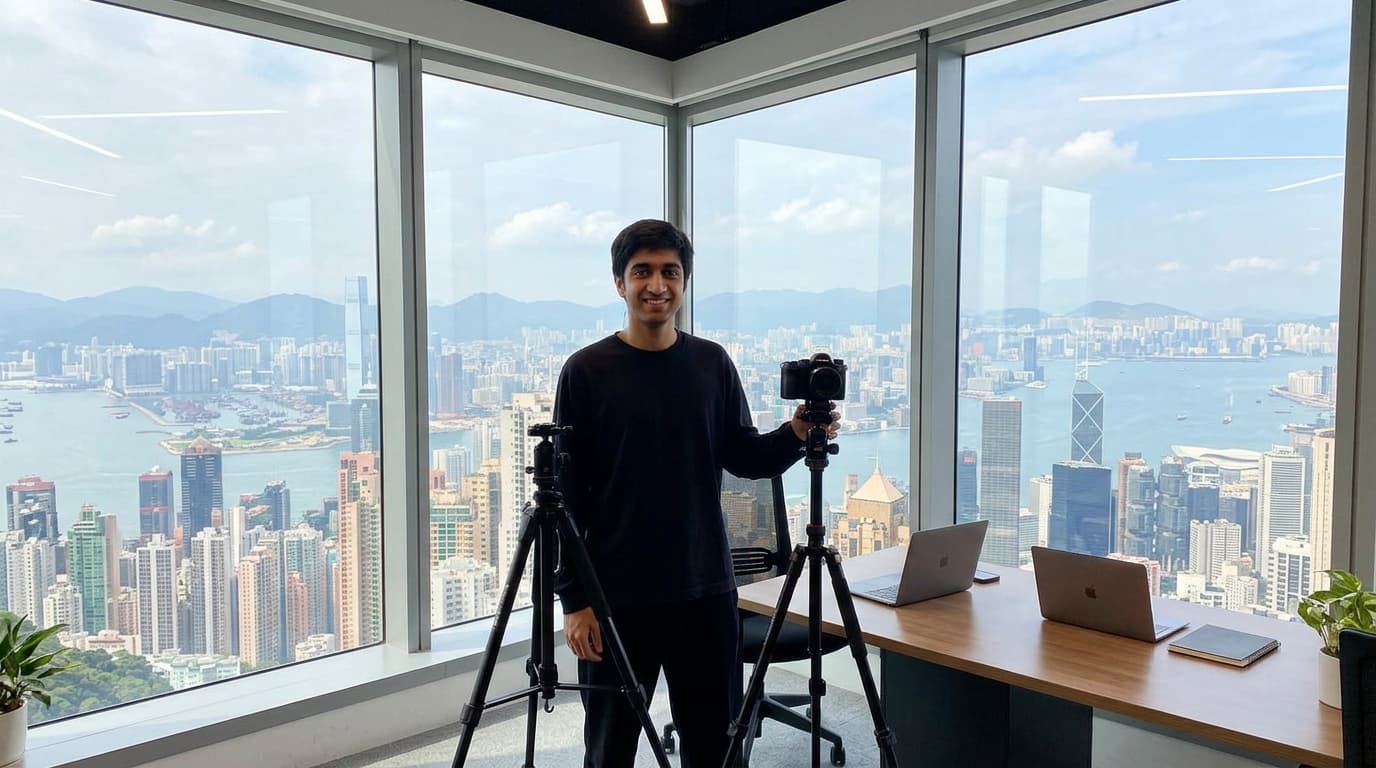
The LinkedIn feed has effectively become a television broadcast where the commercial breaks are the text posts nobody stays for. While the average B2B professional scrolls past thousands of words of whitepapers and thought-leadership essays every week, they stop for the movement, the face, and the direct address of a video.
In the high-stakes environment of Hong Kong business development, where trust is the primary currency, video isn't just a content format-it is a proof-of-life signal. But the bottleneck has always been production. Spending HK$50,000 on a single studio-produced video that becomes obsolete in three weeks is a recipe for a negative ROI. Using AI to bridge this gap is the only way to maintain the volume required to win in the current LinkedIn algorithm.

02The LinkedIn Paradox - High Demand, Low Production
Data from early 2026 shows that while video views on LinkedIn have surged, with overall viewership up 36% year-over-year, the number of businesses producing consistent, high-quality video content remains surprisingly low. This is the opportunity. Most B2B marketers are trapped in a loop: they know video performs better-often seeing 7x more reactions and nearly 30% higher engagement rates than text-but they cannot scale production without ballooning their budgets.
Traditional video production is a linear, human-heavy process. You need a script, a location, lighting, audio equipment, a spokesperson who doesn't stumble, and hours of post-production editing. If you want to change one sentence because of a market shift, you have to reshoot. This friction kills momentum. In a city like Hong Kong, where market conditions can shift with a single HKEX filing or a policy update from the Chief Executive's office, waiting two weeks for a video edit to come back from an agency is effectively the same as not posting at all.
AI video changes the fundamental math of LinkedIn growth. Instead of a linear production cost, you move to a programmatic infrastructure. You are no longer filming; you are generating. You are shifting from a 'craft' model to an 'engineering' model, where video assets are created as part of a high-velocity data pipeline.
03The Cost of Staying Traditional - A Financial Autopsy
When you look at the breakdown of costs, the disparity between traditional production and AI workflows is jarring. For a typical B2B brand in Hong Kong, the economics of AI video enable a level of testing and market penetration that was previously reserved for MNCs with multi-million dollar creative budgets.
| Metric | Traditional Video Agency | In-House Production (iPhone) | AI Generation Workflow |
|---|---|---|---|
| Direct Cost per 60s Video | HK$15,000 - $60,000 | HK$3,000 (Time/Salary) | HK$15 - $250 |
| Total Production Time | 14 - 21 Days | 2 - 5 Days | 10 - 20 Minutes |
| Scaling Capacity | 1-2 videos / month | 2-4 videos / month |
04Deep Dive - The AI Video Stack for HK Founders
In my testing over the last 18 months, several tools have emerged as the clear winners for B2B LinkedIn growth. The key is not to find a 'magical' tool that does everything, but to build a stack that balances realism with speed.
05The Realistic Avatar - HeyGen vs Synthesia
For founders who want to be the face of their brand without spending their life in front of a camera, these two are the industry standard. * HeyGen: Recently, HeyGen has become my preferred tool for 'thought leadership' style videos. Their 'Instant Avatar' technology allows you to upload 2 minutes of smartphone footage and generate a digital twin that mimics your hand gestures and facial tics with uncanny accuracy. On LinkedIn, where people are looking for human connection, these micro-expressions matter. HeyGen's API also makes it incredibly easy to wire into an n8n workflow. * Synthesia: While HeyGen wins on 'natural' feel, Synthesia still owns the 'corporate authority' space. Their avatars are more composed and structured, making them excellent for training videos, product demos, or regulatory explainers. If your brand voice is 'The Trusted Institution,' Synthesia is your move.
06The Viral Hook - Runway Gen-3 and Luma Dream Machine
Sometimes you don't need a talking head; you need a visualization that stops the thumb. Generative video tools like Runway and Luma allow you to create cinematic-quality b-roll from a simple text prompt. Imagine you are writing a post about 'Liquidity Crises in the Greater Bay Area.' Instead of a stock photo of a skyscraper, you can generate a 5-second clip of a neon-lit Hong Kong street where the lights are physically turning into liquid and flowing into a drain. That visual hook is so unique that it forces the user to read your caption. In a sea of boring professional headshots, this is your competitive edge.
07The Native Layer - Captions and OpusClip
Not all AI video is 'generated' from scratch. Some of the most effective LinkedIn videos are 'AI-enhanced.' Tools like Captions (specifically their mobile and desktop apps) use AI to fix your eye contact-so even if you are reading a script, the AI makes it look like you are staring directly into the viewer's eyes. They also add dynamic, high-engagement subtitles that are proven to increase watch time by up to 40% on mobile devices where audio is often muted.
08The 'Founders-Loop' Architecture
To genuinely grow a business on LinkedIn using AI video, you cannot treat it as an occasional task. You must treat it as a pipeline. I call this the 'Founders-Loop.' It is a four-stage engineering process that ensures your LinkedIn presence is always active, even when you are in meetings or traveling.
09Phase 1 - Signal Ingestion (The Brain)
Your pipeline starts by monitoring the sources your clients care about. For a Hong Kong founder, this might include: * RSS feeds of the South China Morning Post (Business section). * Google News alerts for your top 5 competitors. * HKMA and SFC circulars (if you are in finance or fintech). * Direct scraping of the HKEX 'Latest News' page.
When a significant event is detected, n8n triggers the next stage.
10Phase 2 - Strategic Synthesis (The Voice)
The raw news is passed to a high-reasoning model like Hermes or Claude 3.5 Sonnet. The prompt isn't just 'summarize this.' The prompt is: 'You are a Hong Kong-based strategy consultant. Analyze this news through the lens of a mid-market CEO in the logistics sector. Extract three actionable insights. Write a 1-minute video script that starts with a controversial hook and ends with a call to discussion.'
11Phase 3 - Programmatic Generation (The Face)
The script is automatically sent to the HeyGen API. The API selects your 'Digital Twin' avatar, selects the background (perhaps a blurred view of the ICC or IFC), and generates the video file. Within 5 minutes of a market event, you have a high-quality video file ready for review.
12Phase 4 - Human-in-the-Loop (The Quality Gate)
I do not recommend fully automated posting. The 'Founders-Loop' should always include a final human check. The generated video and the suggested LinkedIn caption are sent to a Slack or Discord channel. You (or a trusted team member) watch it, give it the 'thumbs up,' and n8n then pushes it live to LinkedIn via their API or a scheduling tool like Buffer.
13Case Study - Wealth Management Firm in Central
A mid-sized wealth management firm in Hong Kong was struggling to stay relevant on LinkedIn. Their advisors were too busy managing portfolios to film videos, and their agency was charging HK$40,000 a month for four 'static' posts that were getting zero engagement.
We implemented an AI video pipeline that monitored global market volatility. Every time the Hang Seng Index moved by more than 2% in a day, the system automatically generated a video of the firm's Managing Director (via an AI avatar) explaining the movement and what it meant for HNWIs.
The Result: * Volume: Increased from 4 posts/month to 22 posts/month. * Engagement: Video posts saw a 450% increase in comments compared to their previous static image posts. * Lead Gen: They tracked 12 high-value inquiries directly to the 'Market Update' video series in the first 90 days. * Cost: The total software stack cost was less than HK$2,000/month-a 95% reduction from their agency fee.
14Sector-Specific Strategies for Hong Kong
15Logistics & Supply Chain
In a city that serves as the world's transshipment hub, information speed is everything. Use AI video to provide daily 'Port Status' updates or 'Freight Rate Analysis.' Use generative AI (like Runway) to show maps of shipping routes with real-time delays visualized. This positions your firm as the 'Information Leader,' making you the default choice when a client needs a reliable partner.
16Professional Services (Law & Accounting)
The challenge here is the 'dry' nature of the content. Use AI to turn a 50-page tax update into a 60-second video of an avatar law partner explaining the 'Three things you must do before April 1st.' Use the AI's ability to localize to generate the same video in English, Cantonese, and Mandarin to cover the entire Greater Bay Area market perfectly.
17Tech & SaaS
For software founders, AI video is the ultimate demo tool. Use tools like Guidde or Arcade to generate AI-voiced walk-throughs of your new features. These are much more engaging than a bunch of screenshots and can be generated the moment your engineers push code to production.
18The LinkedIn Algorithm in 2026 - What Actually Works?
The algorithm has evolved to prioritize 'durable engagement.' This means that a video that gets watched to completion and triggers a long-form comment from another high-authority user will be pushed to thousands of more feeds.
- The First 3 Seconds: You must use an AI-generated hook-either a provocative statement or a high-contrast visual.
- The Subtitle Factor: 80% of LinkedIn users watch video without sound. If your AI doesn't add perfect, readable, and 'pacing-aware' subtitles, your video is invisible.
- The 'Native' Format: Square (1:1) or Vertical (9:16) video always beats Horizontal (16:9) on mobile. Use AI to automatically reframe your content for the mobile-first professional.
- The Commentary Loop: The video is only half the battle. Your LinkedIn caption should provide a 'Second Hook' that encourages people to click 'See More.' Use your AI scripting layer to generate this caption at the same time as the video.
19Overcoming the 'Stigma' of AI
There is a lingering concern that 'people will know it is AI.'
In the Hong Kong professional market, the transparency trend is winning. Many successful founders are now adding a small disclaimer or a 'Watermark' that says 'Strategic Insight by [Founder Name] | Produced by [Brand] AI.'
Surprisingly, this doesn't decrease engagement; it increases it. It shows that your firm is at the forefront of technology. It signals that you are an efficient, engineering-led organization. In 2026, being 'AI-powered' is a badge of honor, not something to hide. It says to your clients: 'I value my time and your attention enough to use the best tools on the planet to deliver this insight to you as fast as possible.'
20The Roadmap - From Zero to Video Leader in 30 Days
If you are starting from scratch, don't try to build the 'Founders-Loop' on day one. Follow this 30-day escalation:
- Days 1-7 (The Enhancement Phase): Download the Captions app. Record 3 short videos of yourself on your phone. Let the AI add subtitles and fix your eye contact. Post them and watch the engagement shift.
- Days 8-14 (The Avatar Phase): Create your digital twin on HeyGen or Synthesia. Generate 2 videos using a script you wrote yourself. Focus on getting the 'voice' right.
- Days 15-21 (The Integration Phase): Use n8n to connect your email or a news feed to your AI video tool. Automate the 'Draft' stage so that every time you see a good article, you can turn it into a video script with one click.
- Days 22-30 (The Scaling Phase): Run your first A/B test. Post a text version of an insight on Tuesday and a video version on Thursday. Analyze the data. You will never go back.
21The Sovereign Advantage
By building this infrastructure, you are creating a 'Sovereign Content Engine.' You are no longer dependent on the availability of a videographer, the mood of a spokesperson, or the high margins of a creative agency. You own the models, you own the pipelines, and you own the attention of your market.
In a competitive landscape like Hong Kong, where every commercial sector is crowded, the winner is usually the one who can remain 'top of mind' for the longest period. AI video gives you the stamina to stay in the conversation indefinitely.
The infrastructure you build today to handle LinkedIn video will be the same infrastructure you use tomorrow for personalized sales videos, AI-powered customer support, and internal training. You aren't just making videos; you are building the communication layer of a modern, engineering-led enterprise.
22Technical Deep Dive - Setting Up Your n8n Narrative Engine
To truly understand how to scale this, we need to look under the hood of the automation layer. n8n is the 'Grand Orchestrator' here. Most marketers try to use Zapier, but they quickly hit the 'Logic Ceiling.' Zapier is great for 'If This, Then That.' Engineering-led growth requires 'If This, Then Analyze This, Compare with That, Branch into These Three Options, and then Finally Do This.'
23Step 1 - The 'Trigger' Nodes
Your n8n workflow begins with one of three triggers: 1. Schedule Trigger: Runs every morning at 8:00 AM HKT. 2. Webhook Trigger: Fired when you 'star' an article in your RSS reader (like Feedly). 3. HTTP Request Node: Polls the HKMA 'Press Releases' JSON endpoint every 15 minutes.
24Step 2 - The 'Intelligence' Nodes
Once the data is in, you need to filter the noise. You don't want to make a video about every minor update. You use an 'AI Agent' node in n8n, powered by a model like Hermes 3 on a local server or a high-end cloud provider. The agent's task is 'Relevance Scoring.'
*Example Scorecard:* * Does this affect HK-based SMEs? (+3 points) * Is this about AI or Digital Transformation? (+5 points) * Is it a regulatory change? (+4 points) * Is it just a PR fluff piece? (-10 points)
If the score is above 7, the workflow continues.
25Step 3 - The 'Creative' Nodes
This is where the script is generated. But a script isn't enough. You also need a 'Visual Brief' for the B-roll. The n8n workflow branches here: * Branch A: Sends the text to HeyGen to generate the talking head. * Branch B: Sends a visual description to Runway Gen-3 to generate a background clip. * Branch C: Generates 3 options for the LinkedIn post text, optimized for different 'Hooks.'
26Step 4 - The 'Assembly' Nodes
Using a tool like Shotstack or the HeyGen internal editor, the talking head video, the Runway background, and the captions are layered together. The result is a professional-grade video that looks like it took a day to edit, but was actually assembled in the cloud in 180 seconds.
27The Psychology of Social Selling in the AI Era
Why does video actually work on a psychological level? It comes down to the concept of 'Para-social Interaction.' When a prospect sees your face and hears your voice consistently, their brain begins to categorize you as a 'known entity' rather than a 'cold contact.'
In the Hong Kong business culture, 'Guanxi' (relationships) is often built over tea or dinner. While AI video cannot replace a face-to-face meeting, it acts as a 'Guanxi-Accelerator.' By the time you actually walk into the boardroom in Central, the client has already 'met' you ten times on their LinkedIn feed. They know your stance on market trends. They have seen your expertise in action. The video has done the hard work of 'pre-selling' your authority.
28The Credibility Gap
The biggest mistake founders make with AI video is trying to be someone they are not. If your natural speaking style is humble and data-driven, do not program your AI avatar to be loud and 'hype-heavy.' The most successful AI digital twins are those that lean into the founder's actual personality quirks.
29The Future - Personalized Video DM Pipelines
The logic we have discussed for the LinkedIn 'Public Feed' is now moving into the 'Private Message' space. In 2026, the highest-performing sales teams in Hong Kong are not sending text-based LinkedIn InMails. They are sending personalized AI videos.
Imagine a prospect visits your pricing page but doesn't sign up. 1. Clearbit or a similar tool identifies their company. 2. n8n pulls the prospect's LinkedIn profile. 3. HeyGen generates a 20-second video where your avatar says: 'Hi [Prospect Name], I saw you were looking at our [Specific Product] page. Most [Industry Name] firms in Hong Kong use that to solve [Specific Pain Point]. Would you like a 5-minute walk-through?'
This level of 1-to-1 video personalization at scale is the 'Holy Grail' of B2B sales. It is currently being pioneered by a handful of engineering-led startups, and soon it will be the standard for all professional services.
30Why This Matters for the 'Greater Bay Area' Strategy
As Hong Kong becomes further integrated into the Greater Bay Area (GBA), the audience you are targeting is no longer just the 7 million people in HK, but the 86 million people in the region.
Translating your content into Simplified Chinese and creating videos that resonate with the tech hubs of Shenzhen and the manufacturing giants of Guangzhou is a massive task. AI video makes this effortless. With one click, your LinkedIn strategy can be mirrored on WeChat Channels (视频号), with perfect local dialect and cultural nuances handled by the AI layer.
This 'Arbitrage of Information'-taking global trends and explaining them to the GBA market via video-is one of the most profitable moves a Hong Kong founder can make in the next 24 months.
31Final Thoughts - The Engineering of Trust
We are moving away from the 'Era of the Creative' and into the 'Era of the Systems Thinker.' On LinkedIn, the businesses that will dominate are those that view content not as a series of 'creative projects,' but as a robust, engineering-led infrastructure for building trust at scale.
AI video is the most potent weapon in this new landscape. It combines the human element that LinkedIn craves with the computational speed that modern business demands.
The question for you is no longer 'Should I do video?' The question is: 'When will I stop being the actor in my content, and start being the director of the system that produces it?'
*I build engineering-led growth systems for Hong Kong's most ambitious businesses. If you want to stop chasing the algorithm and start owning your market infrastructure, visit sheryarshah.com.*
Filed under
videolinkedinbusinessgrowhigh
Keep reading
More essays on AI growth, SEO & the web.