All writing
Agentic SEO15 min read
How to Scale From One Location to Many Using Programmatic SEO
How to Scale From One Location to Many Using Programmatic SEO — a practical guide for Hong Kong businesses.
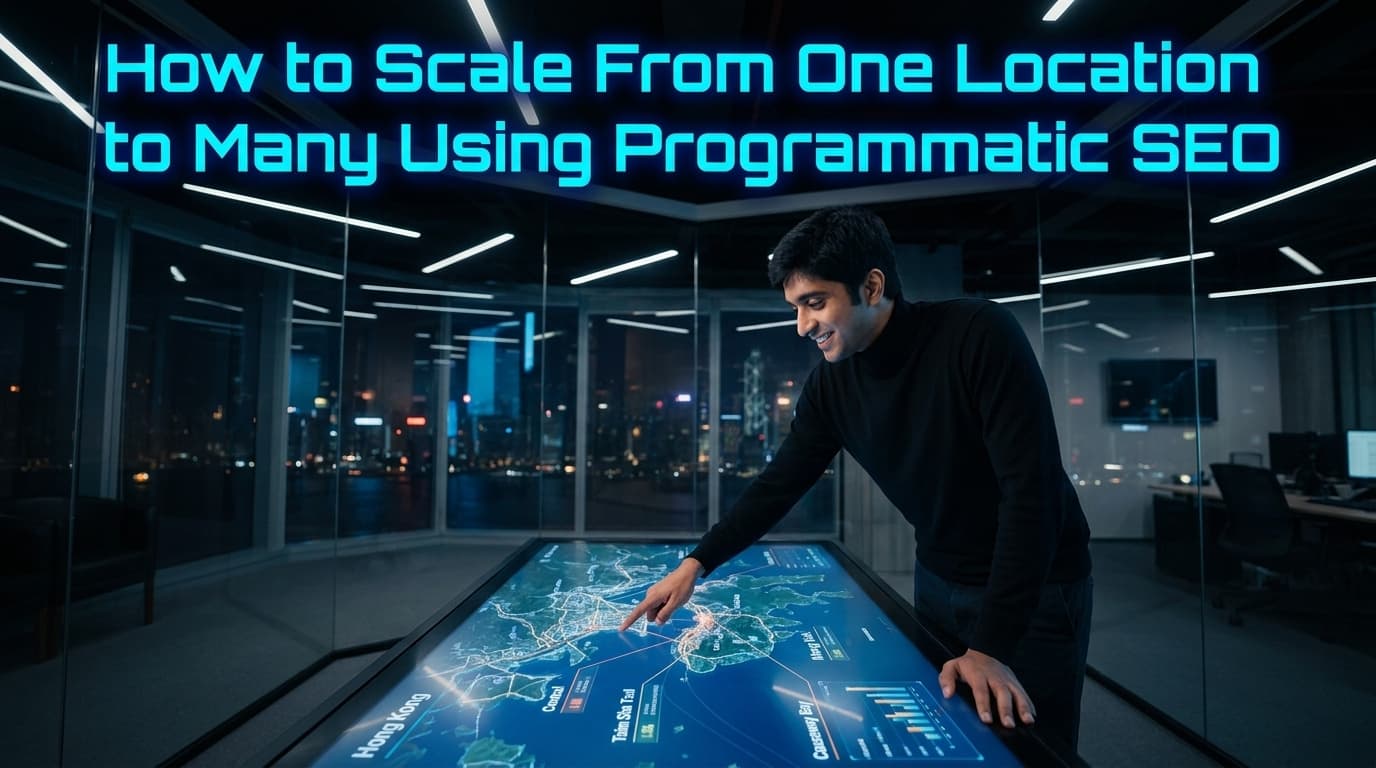
Standing on the Star Ferry as it crossed from Tsim Sha Tsui to Central, I watched the skyline and realized that my business’s digital footprint was as limited as a single-room office in a Kowloon industrial building. I had one great location page, one decent ranking for my main office, and 45 other districts in Hong Kong where I was effectively invisible. If you are running a service-based business or a retail chain, you know this pain-the crushing realization that manual SEO is a linear game in an exponential world. You can spend forty hours perfecting one landing page for “Web Design in Central,” but by the time you finish doing the same for Mong Kok, Causeway Bay, and Shatin, the market has moved on and your competitors have already captured the local intent.
Scaling from one location to many requires a fundamental shift in how you view content creation. It is no longer about writing; it is about engineering. This is where Programmatic SEO (pSEO) comes in-a methodology that allows us to build thousands of high-quality, intent-focused pages using code, data, and templates. In my journey as a founder in the Hong Kong tech ecosystem, I have seen that the difference between a local shop and a regional powerhouse often comes down to who can capture local search volume at scale.
02The local search reality in 2026-Beyond the basics
The traditional approach to local SEO is dead-or at least, it is too slow to survive the current pace of the internet. Statistically, 46% of all Google searches now have a local intent. If you aren’t appearing when someone searches for a service “near me,” you are leaving nearly half of your potential revenue on the table. But the market is becoming more granular. Users aren't just searching for things in "Hong Kong" anymore; they are searching for "Coworking space in Kwun Tong" or "IT support in Cyberport."
I’ve seen data from 2025 showing that programmatic SEO implementations can drive a 220.65% increase in organic traffic within a single quarter. This isn't just a slight improvement-it is a categorical leap in how a business acquires customers. When you scale from one location to many, you aren't just multiplying your pages; you are multiplying your entry points into your brand's ecosystem.
In a city like Hong Kong, where every street corner represents a different demographic and business density, the ability to tailor your message to the specific needs of a district like Sham Shui Po versus the luxury-focused needs of Mid-Levels is a competitive advantage that cannot be overstated. We are moving into an era where "relevance at scale" is the only metric that truly determines market share in the organic space.
03Designing the architecture-Data is your foundation
Before you write a single line of code, you need a database. Most founders make the mistake of starting with the content, but the magic of programmatic SEO lies in the data structure. You need a comprehensive list of every location you want to target, matched with the specific variables that make those locations unique.
In the context of the Hong Kong market, your data set might include: * District Name (e.g., Wan Chai, Sai Kung, North Point) * Neighborhood Landmarks (e.g., near Times Square, close to the MTR station) * Service Specifics (e.g., 24/7 availability in this specific zone) * Local Statistics (e.g., population density or number of businesses in that area) * Testimonials from clients in that specific district * Regional nuances (e.g., specific dialects or industrial focuses like the 'Design District' in Sham Shui Po)
By structuring this data in a tool like Supabase or even a well-organized Airtable, you create a "truth source" that your programmatic engine can pull from. This ensures that every page you generate isn't just a carbon copy of the last with a find-and-replace on the city name. Google’s algorithms in 2026 are far too smart for that. They look for “helpful content,” and nothing is less helpful than 50 pages that all say the exact same thing except for the name of the street.
The complexity of your data dictates the depth of your content. If you only have "City Name," your content will be shallow. If you have "Zip Code," "Local Neighborhood Hero," "Historical Fact," and "Popular Local Cuisine," you can build a page that feels like it was written by a local resident. This is the difference between automated spam and automated value.
04Building the programmatic engine-Technical implementation
To scale effectively, you need a stack that can handle dynamic routing and static generation. I personally prefer using Next.js with a headless CMS or a direct database connection. The goal is to create a single template file that acts as a blueprint for every location page.
Here is a simplified example of how we might structure a script to generate slugs and metadata for dozens of Hong Kong districts programmatically:
python
import pandas as pd
import json

# Sample data set of Hong Kong districts for programmatic generation
districts = [
    {"name": "Central", "region": "Hong Kong Island", "key_feature": "Financial Hub"},
    {"name": "Mong Kok", "region": "Kowloon", "key_feature": "Highest Population Density"},
    {"name": "Tsuen Wan", "region": "New Territories", "key_feature": "Residential and Industrial Mix"},
    {"name": "Kwun Tong", "region": "Kowloon", "key_feature": "Emerging Tech & Industrial Hub"},
    {"name": "Causeway Bay", "region": "Hong Kong Island", "key_feature": "Retail and Commercial Center"}
]

def generate_seo_metadata(district):
    # Constructing a slug that is search-engine friendly
    slug = f"services-in-{district['name'].lower().replace(' ', '-')}"

    # Building a title that uses the key feature for uniqueness
    title = f"Professional {district['key_feature']} Services in {district['name']} - 2026 Guide"

    # Description includes region and key feature to increase keyword density naturally
    description = (f"Need reliable help in {district['name']}? As the {district['key_feature']} "
                   f"of {district['region']}, we offer specialized solutions tailored for the "
                   f"local {district['name']} community.")

    return {
        "slug": slug,
        "title": title,
        "description": description,
        "district_data": district
    }

# Process the database to create our page list
programmatic_pages = [generate_seo_metadata(d) for d in districts]

# Output to JSON for our frontend ingestion or static site generation (SSG)
with open('location_pages_config.json', 'w') as f:
    json.dump(programmatic_pages, f, indent=4)

print(f"Successfully generated {len(programmatic_pages)} unique location profiles.")
This script is the heartbeat of your scaling strategy. It allows you to transform a row of data into a unique URL and a unique set of meta tags. From there, your frontend framework takes over, rendering a page that looks and feels hand-crafted but was actually generated in milliseconds.
The beauty of this approach is that when you want to update your pricing or your service offering across all 50 locations, you don't edit 50 pages. You edit one template, run your build script, and the entire site is updated in minutes. This is how you reclaim your time as a founder.
05Creating unique value-The “Thin Content” trap
One of the biggest risks when scaling from one location to 500 is being flagged for thin content. If every page is 95% identical, Google will eventually de-index them, and all your hard work will vanish. To avoid this, you must inject “variable clusters” into your templates.
Variable clusters are blocks of content that change based on broader categories. For example, if a location is in the “New Territories,” you might include a section about logistics and transit times that are specific to that region-perhaps mentioning the boundary crossing or the specific industrial parks like the Hong Kong Science and Technology Park (HKSTP). If the location is on “Hong Kong Island,” you might pivot the content to focus on corporate efficiency, the proximity to the IFC, and high-end service delivery.
Beyond simple text substitution, you should consider: * Dynamic Image Selection: Show a photo of the actual district. * Localized FAQs: "How long does it take to reach Mong Kok from here?" * Specific Partner Listings: "We work with local businesses in the Ap Lei Chau area." * Weather or Traffic Widgets: Real-time data that makes the page feel alive.
06Local schema markup-The invisible advantage
In 2026, schema markup is not optional. When you scale programmatically, you must ensure that every page includes valid LocalBusiness or Service schema. This structure tells search engines exactly what the page is about in a language they understand perfectly.
Research shows that around 72% of consumers who do a local search visit a store within five miles. By programmatically including GPS coordinates, opening hours, and specific district-level reviews in your JSON-LD schema, you are feeding the search engine exactly what it needs to trigger those “near me” results.
In your programmatic template, the schema should be dynamic. The latitude and longitude should change for every district. The address field should reflect the specific borough. This signals to Google that these aren't just generic pages; they are highly specific pointers to a real-world service area.
07Integrating Google Business Profile (GBP) with pSEO
You cannot talk about location scaling without talking about Google Business Profile. Your programmatic pages should be the “landings” for your GBP listings. If you have 10 physical branches, you should have 10 hyper-optimized programmatic pages that these listings link to.
If you don't have physical branches in every district, you can still dominate through "Service Area Pages." However, the connection is key. I always recommend embedding a live Google Map on each programmatic page that is centered on the specific district or neighborhood. This creates a bridge between your website's content and Google’s own map data, increasing the perceived authority of the page.
Furthermore, you should use the Google Business Profile API to pull in your latest reviews and posts onto your programmatic pages. This creates a feedback loop: your website stays updated with fresh content from your GBP, and your GBP gets high-quality traffic from your website.
08The power of internal linking at scale
As you move from 1 to 100+ pages, your site’s internal linking structure becomes a critical ranking factor. You don't want these new pages to be “orphans” that aren't linked from anywhere else. I use a “hub and spoke” model that mimics the geographical structure of the city.
- The Master Hub: Your main “Locations” page listing the broad territories (Hong Kong Island, Kowloon, New Territories).
- The Territory Hubs: Pages focused on specific regions (e.g., “Professional Services in Kowloon”). These pages link to all the districts within that region.
- The District Spokes: The individual district pages (e.g., “Services in Tsim Sha Tsui”). These link back to their Territory Hub and to neighboring districts.
This hierarchy passes “link juice” efficiently and leads crawlers through a logical path. In my experience, websites that use this structured approach see their new pages indexed 50% faster than those with a flat structure. It also creates a better user experience, as visitors can easily navigate to nearby areas.
09Metrics that matter-Measuring the success of your expansion
Once the engine is running and the pages are live, you need to track more than just “total traffic.” You need to look at “Local Visibility.” Are you winning the featured snippets for district-specific queries?
When we look at case studies from 2024 and 2025, we see that the most successful pSEO campaigns don't just target high-volume keywords. They target “Zero Volume” keywords-clusters of searches so specific that traditional SEO tools don't even track them. But when you aggregate 500 of these “zero volume” districts, you end up with a massive stream of highly qualified, low-competition traffic.
Key performance indicators (KPIs) for multi-location pSEO: * Average Position per District: Tracking if you are in the top 3 for the specific "Service + District" keyword. * Local Glimpse Rate: How often your GBP appears in the "Map Pack" alongside your programmatic page. * Conversion Rate by Region: Determining if certain districts (like Central) have a higher intent than others (like Sai Kung). * Indexing Rate: What percentage of your 500+ generated pages are actually in Google's index?
In Hong Kong, specifically, the competition for “Web Design HK” is fierce. But the competition for “Web Design for Law Firms in Wong Chuk Hang” is virtually non-existent. That is where the programmatic advantage lies. You are playing a game of volume that your competitors are too manual to participate in.
10Adapting for the Greater Bay Area-The future of scaling
As a founder based in Hong Kong, I am always looking at the Greater Bay Area (GBA). Scaling from HK to Shenzhen, Guangzhou, or Macau presents a unique challenge: language and platform shifts. Programmatic SEO makes this transition manageable. By adding a “Language” variable to your database, you can generate Traditional Chinese, Simplified Chinese, and English versions of your location pages simultaneously.
The localization isn't just about language; it’s about cultural context. A location page for a service in Shenzhen should emphasize different value propositions than one in Central. Since the digital ecosystem in mainland China is different, your programmatic templates for those regions might prioritize different CTAs, such as WeChat QR codes instead of WhatsApp links.
This is the "Modular" approach to pSEO. You don't just change the words; you change the entire functional block of the page based on the geographical region. This level of sophistication is what separates a true regional player from someone just trying to rank a few pages.
11Pitfalls to avoid-The founder’s checklist
Over the years, I have made every mistake in the book when it comes to automation. Here is how you avoid the most common traps and ensure your scaling effort doesn't blow up in your face:
- Canonicalization errors- This is the silent killer of pSEO. Ensure each page has a self-referential canonical tag. If you don't, Google might think your Tsim Sha Tsui page and your Mong Kok page are duplicates and hide both.
- Slow load times- If you are generating 1,000 pages, ensure your images are optimized at scale. Don't use the same 5MB hero image for every page. Use a CDN and ideally, dynamic image generation that overlays the district name on a hero banner.
- Ignoring the user- If a user lands on a “Mong Kok” page and everything they see is about “Central,” they will bounce immediately. Bounce rates are a ranking signal. Your content must actually reflect the location it claims to serve.
- No call to action- Don't get so caught up in the SEO that you forget the “C” in CRO (Conversion Rate Optimization). Every page needs a clear, localized CTA. Use dynamic phone numbers or local contact forms to increase trust.
- Neglecting Mobile- In Hong Kong, mobile search is everything. Ensure your programmatic templates are lightning-fast on 5G and perfectly responsive.
12The long-run strategy-pSEO in 2026 and beyond
Looking ahead, the integration of AI with programmatic SEO is the next frontier. We are moving away from simple variable insertion toward “Generative Programmatic.” This means using LLMs to rewrite specific sections of each location page based on real-time data or news from that specific area.
Imagine a page for your business in Shatin that automatically updates its introductory paragraph to mention a local festival or a recent infrastructure development like the Tuen Ma Line expansion. This level of hyper-localization was impossible five years ago. Today, it is just a matter of API calls and a well-structured prompt.
However, the "Founder's Voice" must remain. AI can provide the data and the variety, but you must provide the strategy and the unique angle. I always recommend having a "Golden Paragraph" on every page-a section that is 100% human-written and reflects your company's core values, which is then synthetically varied across the locations.
13Data-driven results-The ROI of programmatic scaling
Let's talk numbers. When a SaaS client of ours moved from a manual SEO approach to a programmatic one, they were spending roughly $5,000 USD per month on content writers to produce 10 pages. Each page took two weeks from ideation to publication.
By building a programmatic engine, we were able to launch 300 pages in a single month for an initial technical setup cost of $8,000 USD and a monthly maintenance cost of nearly zero. The cost per page dropped from $500 to $26. Within six months, those 300 pages were generating 40% of their total organic lead volume.
The ROI on pSEO isn't just about the money you save on writers; it's about the speed of market entry. In a competitive city like Hong Kong, being first to market for a specific neighborhood keyword can give you a "first-mover advantage" that lasts for years.
14Conclusion-The founder's perspective on growth
Scaling from one location to many isn't just a technical challenge-it’s a mindset shift. You have to stop being a craftsman and start being a factory owner. You have to trust the systems you build to represent your brand across hundreds of digital touchpoints.
In the dense, competitive landscape of Hong Kong, being “everywhere” is a massive competitive moat. When your potential clients see your brand popping up whether they are at home in the New Territories or at their office in the CBD, you build a level of perceived authority that no amount of traditional advertising can buy.
Programmatic SEO is the use that allows a small team to act like a multinational corporation. It is how we, as founders, reclaim our time while simultaneously scaling our impact. The tools are here, the data is available, and the search intent is clearer than ever. The only thing left is to start building.
We are no longer limited by the number of words we can write in a day-only by the quality of the systems we can design. Whether you are targeting ten districts in Hong Kong or ten thousand cities across the globe, the path to the top of the SERPs is no longer a climb-it’s an automated ascent.
I started this journey looking at the Hong Kong skyline and feeling small. Today, I look at that same skyline and see a map of opportunities, each one a data point ready to be captured by a well-engineered programmatic strategy. It’s time to stop editing pages and start engineering growth.
The statistics are clear: the future of search is local, and the future of local is programmatic. With a 220% growth potential sitting behind a well-executed pSEO strategy, the question isn't whether you should scale-it's how fast you can deploy. Don't let your business be confined to a single district. The city is big, and your digital footprint should be just as large.
15Key Takeaways for Scaling with pSEO
- Structure first- Build a robust database of location-specific variables before touching your CMS.
- Template with logic- Use conditional content and variable clusters to avoid the thin content penalty and provide real value to local searchers.
- use technical stacks- Use frameworks like Next.js and databases like Supabase to handle high-volume page generation with ease.
- Don't forget the map- Integrate Google Business Profile, local reviews, and dynamic schema to win the "near me" search battle.
- Think regional- Use pSEO to expand beyond your immediate vicinity into markets like the Greater Bay Area with localized language and platform variants.
- Focus on conversion- Ensure every programmatic page has a localized call to action and mirrors the specific needs of the district it targets.
- Measure hyper-locally- Track rankings and conversion rates at the district level to understand which markets are truly moving the needle for your business.
By implementing these strategies, you aren’t just building pages-you are building a digital empire that operates while you sleep, capturing intent at every corner of the map. In the world of 2026 SEO, the winners are those who can balance the scale of automation with the precision of local relevance. The era of manual location landing pages is over. The era of the automated founder is here.
Filed under
locationmanyprogrammaticcentralbusiness
Keep reading
More essays on AI growth, SEO & the web.