All writing
AI & Automation18 min read
Why Every Hong Kong Business Should Have an AI Agent in 2026
By 2026, AI agents will be the new baseline for HK business. Learn why you need a local, sovereign AI stack to survive the shift from chatbots to...
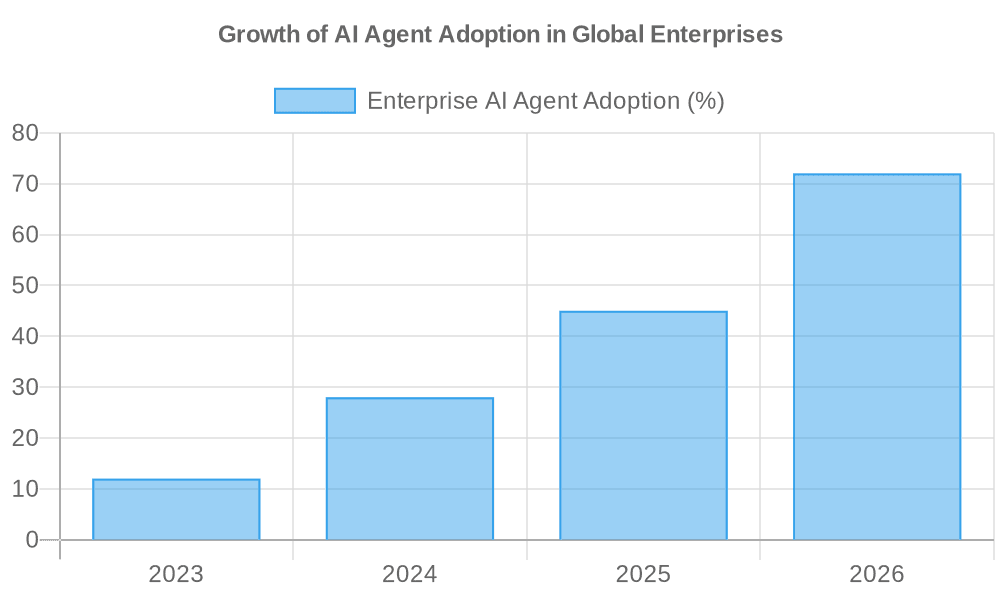
By January 2026, the Hong Kong Monetary Authority (HKMA) projects that over 80% of major financial institutions in the city will have moved past 'exploratory' Generative AI and into full-scale 'Agentic' deployment. This isn't just a trend for the big banks in Central; it is the new baseline for every SME from Kwun Tong to Tsim Sha Tsui that wants to survive the next decade.
I have spent the last few years building AI pipelines right here in Hong Kong, and I have seen the shift happen in real-time. We are moving from a world where AI is something you 'talk to' (chatbots) to a world where AI is something that 'works for you' (agents). In 2026, if you are still manually triaging customer emails or wasting your team's time on repetitive document extraction, you aren't just being inefficient-you are being out-engineered.
02The 2026 Reality - From Chatbots to Autonomous Agents
For a long time, Hong Kong businesses thought an AI strategy meant putting a floating bubble on their website and hoping it could answer 'Where is your office?' in Traditional Chinese. That was 2023. By 2026, that level of automation is as antiquated as a fax machine. The floating bubble is a reactive tool; the AI Agent is a proactive employee.
An AI Agent is different. An agent doesn't just respond; it acts. It has tools, it has memory, and it has the authority to complete complex workflows. If a guest at a boutique hotel in Causeway Bay asks for a late checkout, a 2023 chatbot might say 'Please call the front desk.' A 2026 AI Agent checks the PMS (Property Management System), verifies the cleaning schedule, cross-references waitlisted arrivals, calculates a half-day fee, updates the reservation, sends a payment link, and notifies the housekeeping manager-all in four seconds, at 3 AM, without waking a single human employee.
This transition from 'Generative AI' (making text) to 'Agentic AI' (making progress) is the defining business movement of 2026. In Hong Kong's high-rent, high-salary environment, the ability to deploy these agents is not just a competitive advantage; it is a survival mechanism.
03Why 2026 is the Tipping Point in Hong Kong
The convergence of three specific factors has made this year the mandatory year for adoption:
- The Labor Shortage Intensity: Hong Kong's talent gap is widening, particularly in mid-level operations. AI agents are no longer 'replacing' jobs; they are filling roles that founders literally cannot hire for anymore. We are seeing a structural shift where the 'working class' of the business world is becoming a 'digital class.'
- HKMA & Regulatory Clarity: The 'Artificial Intelligence x Authorized Institutions' pillar of the Fintech 2030 strategy has provided the guardrails local businesses needed. We finally have the 'permission' to build high-stakes agents in finance, law, and insurance. The HKMA’s recent circulars have moved from cautionary to encouraging, provided that 'responsible AI' principles are followed.
- Local Model Sovereignty: Models like OpenClaw and localized versions of Llama have finally conquered the linguistic nuances of Hong Kong-the mix of English, Traditional Chinese, and Cantonese slang that used to break older GenAI systems. They understand what 'chut hoh' means in a logistics context and how 'SFC' regulations apply to a specific fund structure.
04The Economic Impact of AI Agents in the HK Workplace
When we look at workforce productivity, the delta between a human-only team and an agent-augmented team is no longer a few percentage points. It is an order of magnitude. A study in late 2025 indicated that firms implementing multi-agent systems saw a 4x reduction in operational overhead within the first six months.
| Capability | Manual Process (Human) | Basic GenAI (2023 Chat) | AI Agent (2026 Pipeline) |
|---|---|---|---|
| Email Triage | 2-4 minutes per mail | 30 seconds (drafting) | 2 seconds (Full Resolve) |
| Inventory Reorder | 1 hour weekly | 15 mins (data entry) | Autonomous (Triggered) |
| KYC/Compliance | 45 minutes | 10 mins (summary) |
05Real Use Cases - Where HK Businesses are Deploying Agents Now
It is easy to talk about 'AI' in the abstract, but let's look at where the actual revenue is being captured in 2026.
061. The Autonomous Export/Import Clerk
Logistics is the backbone of Hong Kong. Traditionally, this involved human clerks manually entering data from messy PDFs provided by shipping lines. This manual entry was prone to error, slow, and expensive. Today, AI agents monitor shared inboxes, extract bill of lading data using vision models, cross-reference it with internal ERP systems, and automatically flag discrepancies to the customs broker. These agents don't get tired, they don't take holidays, and they don't miss a decimal point on a shipping weight.
072. Retail Personalization at Scale
Walk into a high-end mall in Tsim Sha Tsui, and the loyalty programs are now agent-driven. These agents don't just send 'Happy Birthday' emails with a 10% discount code. They analyze real-time foot traffic data, previous purchase velocity, and current climate-driven trends to offer hyper-specific, one-to-one incentives that actually convert. If the agent knows you frequent the mall on rainy Tuesdays and usually buy skincare, it can trigger a personalized offer for a specific brand's new launch when you are within 50 meters of the store.
083. The Legal and Compliance 'Shadow' Agent
For professional services firms in Central, compliance is the biggest overhead. AI agents now perform first-pass reviews on every contract, flagging clauses that deviate from the firm's standard 'Golden Template.' They don't replace the lawyer; they ensure the lawyer only spends time on the 5% of the contract that actually requires a JD's brain. This 'Human-in-the-loop' (HITL) model is the standard for 2026. The agent does the heavy lifting, and the human provides the strategic sign-off.
09Deep Dive - How Agentic Workflows Differ from Traditional Automation
In the past, we had 'Zapier-style' automation. If A happens, do B. This was linear and brittle. If the format of the incoming data changed slightly, the automation broke.
Agentic workflows in 2026 are 'intent-based.' You give the agent a goal-'Make sure all incoming invoices are paid and filed according to HK Inland Revenue Department standards'-and the agent figures out the steps. If it encounters a new invoice format, it uses its vision model to find the 'Total Due' and 'Tax ID' fields. If it finds a discrepancy, it searches your email history to see if there was a negotiated discount. This ability to reason through ambiguity is what makes 2026 the year of the agent.
10Strategic Memory - The Secret Sauce
The most advanced Hong Kong businesses are now building 'Memory Layers' for their agents. This isn't just a database; it is a semantic index of everything the business knows. When an agent answers a customer question, it doesn't just look at the latest FAQ. It looks at every previous conversation that customer has ever had with the company. It knows that the customer complained about delivery speed last year, so it adds a proactive apology and a 'fast-track' shipping option to the current interaction.
11Building Your Own 'Sovereign' Agent Stack
Most founders I talk to in Hong Kong make the same mistake: they buy a subscription to a 'wrapper' startup in Silicon Valley and hope it works for their business here. They pay ,000 USD a month for a tool that they don't control, that doesn't understand the local context, and that could change its pricing or disappear tomorrow.
That is not a strategy; that is a dependency.
In my view, every Hong Kong business needs to own its intelligence infrastructure. This usually means a 'Sovereign Stack' consisting of:
- The Brain: A local or high-performance LLM (like Hermes 3 or GPT-4o) configured with your specific business context.
- The Memory: A vector database (like Supabase or Qdrant) that stores every customer interaction, every product spec, and every internal SOP (Standard Operating Procedure).
- The Arms: Automation tools (like n8n) that allow the brain to actually click buttons, send emails, and update databases.
When you own this stack, you aren't just renting a tool. You are building a digital asset that increases in value every day it runs. It learns your customers' quirks. It understands your product's edge cases. It becomes your most valuable employee-one that never quits and has institutional memory that can't be lost to a competitor.
12Overcoming the 'Hong Kong Hurdle' - Security and Trust
The number one reason HK founders hesitate is data privacy. 'Where is my data going?' and 'Will it leak to my competitors?' are the standard questions. This is a valid concern in a city where corporate espionage and data leaks are significant risks.
By 2026, the 'Private Cloud' model has solved this. We are deploying agents that run within a business's own secure VPC (Virtual Private Cloud) hosted on AWS Hong Kong or Google Cloud HK. The data never leaves the 'walled garden' of the company's private server. You get the intelligence of the world's best AI models with the security of a local RAID drive.
Furthermore, the HKMA's strict guidelines on AI explainability mean that the agents we build today are 'auditable.' They don't just give an answer; they provide the reasoning and the source document for every decision they make. If an agent rejects a credit application, it must be able to cite exactly which regulatory clause or internal risk parameter was triggered.
13The Cost of Waiting vs. The Cost of Building
I often get asked: 'Sheryar, should I wait for the technology to get even better next year?'
My answer is always no. The technology is already 1,000x faster than the humans it is assisting. The bottleneck is no longer the AI's intelligence; it is your business's data readiness.
An AI agent is only as good as the data it can access. If your business processes are still trapped in physical notebooks, messy Excel files, and people's heads, you are in 'Data Debt.' Every month you wait to start building your agent infrastructure, your Data Debt grows. While you 'wait for the technology to mature,' your competitors are training their agents on their own proprietary data sets. By the time you start, they will have a 12-month head start in institutional digital intelligence.
Start small. Automate the most annoying 15-minute task in your office. See it work. Then automate the 1-hour task. Then automate the 4-hour task. By the time 2027 rolls around, you won't have to 'figure out AI'-you will have an army of digital agents already running your operations while you focus on high-level strategy and relationship building.
14The Shift in Human Talent - From 'Doers' to 'Orchestrators'
As AI agents take over the 'doing,' the role of the human employee in Hong Kong is changing. We no longer need people to copy-paste data between sheets or write basic email responses. We need 'Orchestrators'-people who can design, monitor, and refine the agentic workflows.
This is a higher-value role. A person who can manage 10 AI agents is worth significantly more to a business than a person who can perform the tasks of 0.5 of a human. For the workforce in Hong Kong, this is an opportunity. It is a chance to move away from the 'drudgery' of administrative work and into the 'architecture' of business logic.
At my firm, we don't look for people who are 'good at Excel.' We look for people who can write a clear, logical prompt and understand how to wire an API. These are the skills of the 2026 economy.
15Hong Kong as a Global AI Agent Hub
There is a unique opportunity for Hong Kong to lead the world in Agentic AI. Because of our compact size, our dense business ecosystem, and our unique position as a bridge between the East and West, we are the perfect laboratory for agent-driven commerce.
An agent built in Hong Kong can seamlessly navigate the regulatory requirements of the GBA (Greater Bay Area) while communicating in perfect English to a client in London and in perfect Mandarin to a supplier in Shenzhen. This 'cultural and regulatory translation' is a superpower that only Hong Kong can truly weaponize at scale.
16Implementation Roadmap - Your First 90 Days
If you are a founder reading this and feeling overwhelmed, here is your 90-day roadmap to becoming an agentic business:
Day 1-30: The Data Audit. Identify where your business knowledge lives. Digitize everything. If it's on paper, scan it. If it's in a head, document it. This is the 'fuel' for your agents.
Day 31-60: The First Pipeline. Choose one repetitive, high-volume task. For many, this is 'Customer Inquiry Triage' or 'Daily Performance Reporting.' Build a simple n8n workflow that uses an LLM to process the data and output a result. Set it to 'Draft Mode' where a human must click 'Approve' before anything is sent.
Day 61-90: Scaling and Memory. Once the first pipeline is trusted, remove the 'Approve' button for standard cases. Add a vector database so the agent can remember past interactions. Start exploring a second use case in a different department.
By Day 91, you aren't just a business owner; you are an AI operator.
17Conclusion - Lead or Be Optimized
Hong Kong has always been a city of middlemen and connectors. But in an AI-first world, the 'middleman' is the first thing to be optimized out by an agent. To survive and thrive in 2026, you must pivot from being a facilitator to being a builder.
Every business in this city-from the corner dai pai dong that uses agents for inventory to the multi-family office in IFC-is now a technology company. You are either the one building the agents, or you are the one whose margins are being eaten by someone else's agents.
At sheryarshah.com, we are helping Hong Kong businesses build the sovereign infrastructure they need to own their future. We don't believe in black-box solutions. We believe in teaching founders how to build their own moats. Don't wait for your competitors to automate you out of the market. The era of the AI Agent is here, and it is the biggest wealth-creation opportunity since the dawn of the internet.
*Ready to build your first AI agent pipeline? Let's talk about how to wire your business for 2026. Visit sheryarshah.com to see our latest blueprints and case studies.*
18Detailed Appendix - The Technical Architecture of a 2026 HK AI Agent
For those who want to know what's 'under the hood,' here is the standard architecture we recommend for Hong Kong SMEs.
191. The Ingestion Layer
This is where the agent gets its data. In 2026, this isn't just about API calls. It's about 'Vision' (the ability to read documents and screenshots) and 'Voice' (the ability to process phone calls). We use tools that can scrape the HKEX filings in real-time or monitor the SFC website for new enforcement notices.
202. The Reasoning Layer (The LLM)
We typically deploy a two-tier LLM strategy. For simple tasks (triage, formatting), we use a fast, low-cost model like GPT-4o-mini or a quantized Llama 3. For complex reasoning (legal analysis, strategic planning), we use a high-order model like Hermes 3 or Claude 3.5 Sonnet. By routing tasks based on complexity, we keep operational costs low without sacrificing intelligence.
213. The Execution Layer (The Tools)
The agent needs 'arms.' We use n8n as the primary orchestration engine because of its visual nature and local hosting capabilities. n8n connects to the business's email (Gmail/Outlook), CRM (HubSpot/Salesforce), and specialized local HK tools like Xero for accounting or custom-built internal APIs.
224. The Guardrail Layer
This is the most critical part of the 2026 stack. Every agentic output is passed through a 'Guardrail Model' that checks for: - PII (Personally Identifiable Information): Ensure no customer IDs or sensitive data is leaked. - Regulatory Compliance: Ensure the response doesn't violate HKMA or SFC guidelines on financial advice. - Brand Voice: Ensure the tone remains professional and consistent with the company's identity.
By building these four layers, you create an agent that is powerful, secure, and aligned with your business goals. This is the infrastructure of the future.
23The Cultural Nuance - Why Imported AI Often Fails in the HK Market
One of the funniest-and most frustrating-things I saw in early 2024 was Hong Kong businesses trying to use AI agents built exclusively on American data sets to handle local customer service. The AI would respond in simplified Chinese (when the customer used traditional), or it would use terminology that made no sense in a local context. It would call a 'flat' an 'apartment' or fail to understand the specific urgency of a 'Type 9' license inquiry.
In 2026, the businesses that are winning are the ones using 'Local Context Injection.' We take the core reasoning power of a model like Hermes and we 'wrap' it in a layer of local knowledge. This includes: - Linguistic code-switching: Understanding when a customer is moving between English and Cantonese in the same sentence (Kongish). - Geographical Intelligence: Knowing that a delivery to 'The Peak' has different logistical constraints than one to 'Mong Kok.' - Socio-Economic Awareness: Understanding the hierarchy of professional titles in Hong Kong and the appropriate level of formality required for different communication channels (WhatsApp vs. Email vs. Formal Letter).
If your agent treats every customer like they are in suburban Ohio, you are going to lose the trust of your local audience. In Hong Kong, speed is important, but 'face' and 'correctness' are equally vital.
24The 'Agentic Dividend' - What to Do with the Saved Time
The most successful founders I know aren't using AI agents just to 'cut costs.' They are using the 'Agentic Dividend'-the time and money saved by automation-to double down on high-value human activities.
When your AI agent is handling 90% of your customer onboarding, your team can spend 100% of their time on the 10% of customers who have complex, high-value needs. Instead of rushing through 50 boring emails, they can have one 60-minute strategic lunch with a key partner.
The businesses that just 'fire the staff' to save money usually find that their brand equity plateaus. The businesses that 'redeploy the staff' to higher-value activities are the ones that see exponential growth. In 2026, the question isn't 'How many people can I cut?' but 'How much more can my existing team achieve with an army of agents at their backs?'
25The Ethics of the Agentic Enterprise
As we move toward a world where agents are making real-world decisions-like who gets a loan or which supplier to hire-we have to talk about ethics. Hong Kong’s regulatory bodies have been very clear: 'Human-in-the-loop' is not just a suggestion; it’s a requirement for high-impact decisions.
We recommend an 'Explainability Dashboard' for every agentic system. This is a simple interface where a human manager can see every decision an agent made, the data it used, and the confidence score it assigned to that decision. If the confidence score is below 85%, the agent must flag the task for human review. This 'Safety First' approach is what allows businesses to scale without taking on existential risks.
Moreover, we have to consider the 'Truth' in our data. If your agent is trained on biased or outdated internal memos, it will reproduce those biases at scale. A 'Data Cleaning' phase is mandatory before any agent is allowed to touch your live customer data.
26Tech Audit - Is Your Current IT Team 'Agent-Ready'?
I often find that the biggest obstacle to AI agent adoption in Hong Kong isn't the founder-it's the legacy IT department. Many IT teams are still focused on 'Maintenance and Security' rather than 'Growth and Intelligence.' They are busy fixing laptops and managing servers when they should be building pipelines.
To be an agentic business, you need Your IT team to evolve into an 'Operations Engineering' team. They need to understand: - API Orchestration: How to move data between 20 different SaaS tools safely. - Prompt Engineering: How to refine the instructions given to the agent to get 99% accuracy. - Vector Database Management: How to store and retrieve business knowledge efficiently. - LLM Observability: How to track the performance and cost of your AI models in real-time.
If your IT team tells you 'AI is too risky' or 'We don't have the budget,' you need to ask if they are protecting the business or protecting their own comfort zone. In 2026, the IT team's primary KPI should be 'Hours of Human Work Automated.'
27The 'Agent-Led' Marketing Strategy for 2026
If you are still hiring an agency to write four blog posts a month, you are living in the past. In 2026, we use 'Agentic Content Pipelines.'
An agent monitors what your customers are actually asking in support tickets. It then identifies a 'Knowledge Gap.' It then drafts a 3,000-word deep-dive article to close that gap. It then creates 10 LinkedIn posts, 5 Twitter threads, and a summary for your newsletter-all before you’ve even had your morning tea.
This isn't about 'spamming' the internet with low-quality content. It's about being the most helpful, responsive, and data-backed business in your niche. When an agent writes content based on your proprietary data, that content is unique, valuable, and impossible for a generic 'content writer' to replicate.
28The Multi-Agent Ecosystem - A New Organizational Chart
In 2026, the concept of a 'department' is being replaced by a 'Multi-Agent System' (MAS). Instead of a Marketing Department and a Sales Department, you have a Marketing Agent that identifies leads, which then hands off a structured 'Lead Context Object' to a Sales Agent, which calculates the personalized offer, which then passes the transaction to a Finance Agent.
This isn't just theory. We are seeing businesses in the GBA (Greater Bay Area) operate with 80% fewer administrative staff by deploying these inter-connected agents. The agents communicate via 'blackboard' systems-shared data spaces where they can post tasks and pick up outcomes from each other.
29The Future of 'Local' Search - Why Agents are the New SEO
Search is changing. In 2026, people don't just type 'best lawyer in HK' into Google and click on three links. They ask their personal AI agent-'Find me a lawyer near Central who specializes in crypto-asset inheritance and has handled cases involving the SFC.'
The agent doesn't browse your website for pleasure. It 'crawls' it for data. This means your website must be 'Agent-Ready.'
30What is Agentic SEO?
Agentic SEO is the process of structuring your business data so that other AI agents can find it, trust it, and recommend it. This involves schemas, topical hubs, and verifiable truth.
31Investing in 'Proprietary Intelligence Labs'
The biggest winners in the Hong Kong market will be the founders who stop viewing AI as an IT expense and start viewing it as an R&D investment. I recommend that every business with more than 20 employees set up a 'Proprietary Intelligence Lab.' This lab codifies your company's secret knowledge into a digital moat.
32Appendix II - Frequently Asked Questions for HK Founders
Q: How much does it cost to set up an AI agent stack? A: A basic stack using open-source tools like n8n and a hosted LLM like GPT-4o-mini can cost as little as 0 USD per month in infrastructure costs.
Q: Does my data go to training the models? A: Not if you use Enterprise API versions.
Q: Can an AI agent handle my accounting? A: It handles the data preparation; your accountant handles the strategy.
Q: How do we start? A: Reach out for a 90-minute Agentic Audit at sheryarshah.com.
Filed under
hongkongeverybusinessagent
Keep reading
More essays on AI growth, SEO & the web.